Isn’t this among the most common bowel problem most individuals, friends and family experience? Yet most people find it very embarrassing to mention in the doctor’s office, especially if it is the opposite sex/ gender. The unfortunate reality is that some people don’t get to identify and/or eliminate the causeof their constipation. And they label it as “It is normal for me to be constipated”
Now, let us look at:
- what exactly is constipation
- which part of our abdomen is responsible the constipation
- the most common causes of constipation
- effective implementation to reduce, eliminate and prevent constipation
What is Constipation?
The Merck’s Manual gives the medical definition of constipation to be: difficult or infrequent passage of stool, hardness of stool, or a feeling of incomplete evacuation. [1] One can experience constipation as either acute onset, or chronic.
Many people incorrectly believe that if one does not have a daily bowel movement, then one considers oneself to be constipated. However, frequency of bowel movement differs with each individual depending on one’s metabolism and other various factors.
Let the bristol stool scale assist you to examine and asses your stool.

Which part in particular in our abdomen is responsible for constipation?
The large intestine is the culprit.
The main function of the large intestine in digestion is to absorb salts and water from the digested food, and pass the waste material on to the rectum for excretion. Absorption of water helps maintain the fluid balance of the body.
What happens when you avoid going to the toilet when the urge comes? Then your intestines continue to absorb more water from the faecal matter, which leaves the end product dry and hard. Then it induces constipation.
What are the top causes of constipation?
- Insufficient fiber and water
- Little exercise & certain emotions
- Sitting position
- Medication side effects
- Gut flora
Fibre
The three different types for fibre
demulcent (linseeds/flaxseeds)
soluble (fruits and vegetables)
in-soluble (wholegrains)
Exercise & Emotions
Your body consist of a sympathetic (flight or flight) and a parasympathetic (rest and digest) nervous system. Now these two systems…..
Siting position
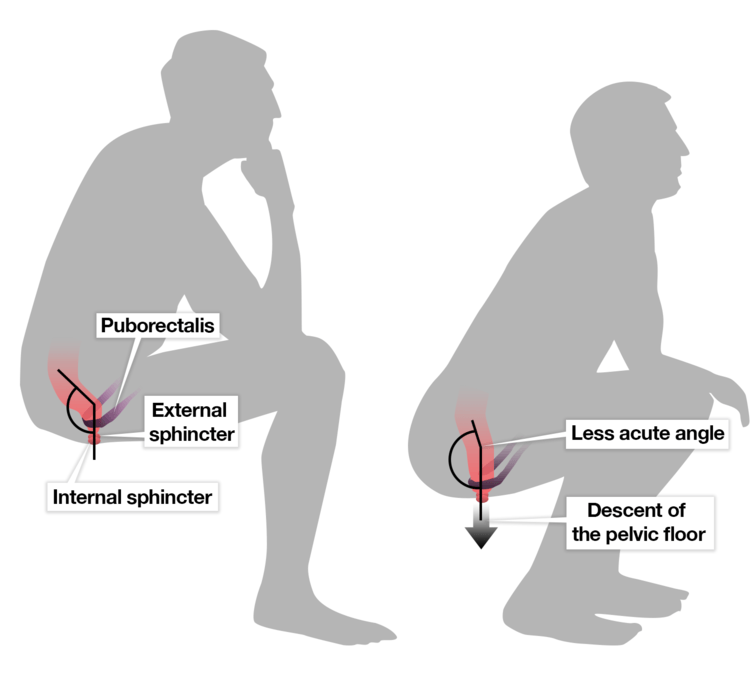
Squatty Potty toilet stools create healthy toilet posture to relieve and prevent constipation in the following ways:
In the squatting position, the puborectalis muscle, allows the anorectal angle to straighten and the bowel to empty completely.
The colon is equipped with an inlet valve (the ileocecal valve) and an outlet valve (the puborectalis muscle). Squatting simultaneously closes the inlet valve, to keep the small intestine clean, and opens the outlet valve, to allow wastes to pass freely. The sitting position defeats the purpose of both valves, making elimination difficult and incomplete, and soiling the small intestine.


Medication
Among the top three of side effects of the majority of medication is constipation. It is good to take caution and read all the possible side effects of your medication, consult with your health care practitioner and find an effective natural to work around it to compliment your medication without the grief of constipation. If you have not earnestly implemented the above mentioned
Gut flora
Microbes are live microorganisms that exist in our bodies and play a role in our general health and wellbeing. While some microbes are bad, the majority are beneficial. These “good bacteria” are called “probiotic,” meaning “for life” in Greek.
Effective implementation to prevent, reduce and /or eliminate constipation
Forever Living products
- Fibre sachets
- Aloe gel dink
- Gin-chia
- Probiotic
# Disclaimer: Please note; if you have incorporated all the above mentioned advice on methods of prevention and/or eliminating constipation for at least two weeks, and your constipation has not been alleviated in any way; Please see a doctor or any other health care practitioner of your choice for further investigation.